

THE URBAN SKETCHING
If you’ve ever sat on a plastic café chair with a sketchbook on your knees / trying to draw a street that refuses to sit still /you already understand urban sketching. Not as a “style,” but as a way of paying attention.
One of the cleanest, most human definitions comes from your prioritized source Urban Sketching World: urban sketching is described as “dynamic, expressive, and community-driven,” capturing the essence of city life through on-location drawing, and functioning as more than a hobby “a global movement” encouraging artists to observe and depict the world around them in real time.
USk’s official language turns that feeling into a standard: an urban sketch is created on location, from direct observation, with any media, telling the story of your surroundings. That “story” part is not decoration it’s the point. In a narrative sense, urban sketching is a cousin of reportage and visual journalism: the Schauplatz essay explicitly frames the movement’s goal as focusing on everyday life and capturing it in drawings “a kind of visual journalism.”
Now let me switch to Rafster tongue for a second: I’m the kind of artist who trusts a messy line more than a perfect one, because a messy line usually means I was there. And that’s the whole game.

History
How urban sketching became a global movement
Your provided sources and USk’s official timeline align on a key point: while people have drawn cities forever, urban sketching as a named, networked movement accelerates with Urban Sketchers (USk). Urban Sketching World credits Gabriel (Gabi) Campanario with creating urban sketching as a formal movement, starting USk in 2007 and growing it through sharing/connection in online spaces.
USk’s “Who We Are” page provides the most authoritative, detailed milestone trail:
In 2007, Campanario creates an online forum (on Flickr) for on-location sketchers; in 2008, the Urban Sketchers blog begins with invited correspondents; in 2009, USk becomes a nonprofit in Washington State; and in 2010, the first International Urban Sketching Symposium is held in Portland, Oregon. USk also records later scale milestones like the 10th anniversary (2017) and passing 300 worldwide chapters (2019).
Schauplatz’s essay reinforces the culture side: it calls Urban Sketchers a “global, networked movement” where anyone can participate and where typical materials include pencil, ink, charcoal, and watercolor.
Styles
Urban Sketching World’s styles guide makes an important humility move: it says the labels are not “official” and the list is not exhaustive its purpose is to show there’s no “right or wrong” way to urban sketch. That mindset matches USk’s diversity principle (the manifesto is a unifying vision, not an aesthetic dictatorship).
A quick visual reset: the community in one photo
This image (from your prioritized “What is Urban Sketching?” post) shows something that matters as much as technique: urban sketching often becomes a social practice sketchcrawls, meetups, and shared pages on the ground.
Key technique definitions you can actually use
“Line and wash” is one of the most common urban sketching approaches, and your prioritized source Urban Sketching World defines it plainly: it’s when linework and watercolor are used together, sometimes called “pen and wash” or “ink and wash.” Encyclopaedia Britannica broadens the concept historically: line-and-wash drawing is a drawing marked out by pen (or similar) then tinted with diluted ink or watercolor, noting examples as far back as 13th-century China.
For ink shading, the styles guide points to artists known for hatching (like Paul Heaston as described there), and Britannica defines hatching as parallel-line shading used especially in media that don’t blend easily (like pen and ink).
For tonal underpainting approaches, the styles guide mentions a grisaille method used by Steven B. Reddy (painting in grayscale then adding watercolor), and Britannica defines grisaille as an image executed entirely in shades of gray, often modeled to create sculptural illusion.
Styles and techniques comparison table
This table translates the “style zoo” into practical choices especially the ones you requested (line, wash, ink, watercolor, digital, animated “Tangier In Motion”). It also nods to categories in your prioritized styles guide (Realistic, Loose, Digital, Reportage) to show how these map together.
| Style / technique | What it is (in street terms) | Best used for | Tools that travel well | Common pitfalls | What to steal from the Urban Sketching World styles guide |
|---|---|---|---|---|---|
| Line-first (pen/pencil) | You “lock the skeleton” first: perspective, gesture, edges | Busy streets, architecture, crowds you can’t pause | Fineliner/fountain pen, pencil, small sketchbook | Over-detailing; stiff lines | The guide highlights realism as hard because accuracy + life must coexist; it praises keeping drawings from becoming stiff using light/air via watercolor + white space. |
| Ink + hatching | Value built from lines (parallel/cross lines) | Night scenes, interiors, strong contrast | Waterproof pen, brush pen | Muddy value if hatching is random; overworking | “Realistic” examples include ink mastery and hatching focus; Britannica anchors what hatching technically is. |
| Line-and-wash / ink-and-wash | Structure from line + atmosphere from diluted color | Travel sketching, medina alleys, cafés, markets | Pen + small watercolor set + waterbrush | Overpainting; losing the line hierarchy | Urban Sketching World’s definition is direct; it also describes switching “line first” vs “paint first” approaches. |
| Watercolor-forward (minimal line) | Color does the heavy lifting; line becomes seasoning | Light, weather, ocean haze, sunset streets | Pocket watercolor set, brush | Washed-out focal points; no value plan | The styles guide notes how watercolor can portray light “elegantly” and how deliberate white space keeps work airy. |
| Loose / expressive | You trade precision for energy (controlled chaos) | When the city is moving too fast to be measured | Anything; often pen + quick washes | Losing readability; everything same weight | The “Loose” section celebrates many kinds of looseness; it cites recognizable continuous-line drawings with loose watercolor accents. |
| Digital urban sketching | On-location sketching on tablet; layers are your safety net | Fast revisions, social-first outputs, travel constraints | Tablet + stylus | Over-editing until the sketch loses “witness” | The styles guide’s “Digital” section highlights iPad-first sketchers and the sketchbook-spread feel (lettering, stamps, graphic edge). |
| Reportage / visual journalism | Drawing-as-reporting: you record what happens now | Events, protests, public life, documentary storytelling | Pen, minimal color, fast notes | Ethical issues; rushing clarity | The guide explicitly links reportage illustration to graphic journalism; Schauplatz frames urban sketching as “visual journalism.” |
| Animated sketch (“Tangier In Motion”) | You animate one truthful element so the sketch breathes | Reels, social storytelling, city-as-cinema | Any sketch + animation tool (Procreate / AE / Dreams) | Gimmicky motion; over-animating everything | USk’s ethos says “any media,” “tell the story,” “share online”—animation can be an extension if it stays truthful to what you witnessed. |
Urban Sketching in Tangier: Lines, Stories, and a Little Bit of Motion
There’s something special about sitting in a corner of Tangier with a sketchbook in your hands. The city doesn’t wait for you. People move, taxis pass, the light shifts every few minutes. You don’t control the scene. You respond to it.
That’s what urban sketching really is.
Not perfect drawings. Not polished illustrations. Just being there, observing, and letting your hand keep up with the moment.
Urban sketching is about drawing on location, from real life. It’s about capturing what you see, but also what you feel in that moment. The noise, the movement, the rhythm of a place. It’s like keeping a visual diary, one page at a time.
And for me, Tangier has been the perfect place to do it.
Drawing Tangier, One Spot at a Time
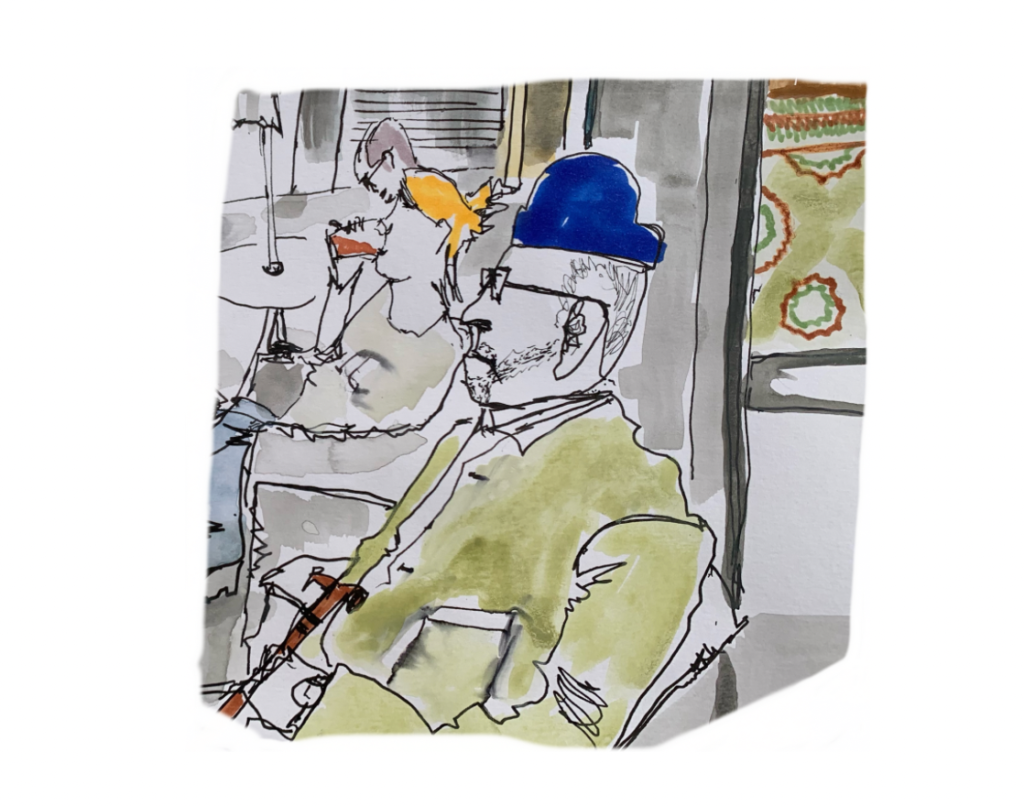
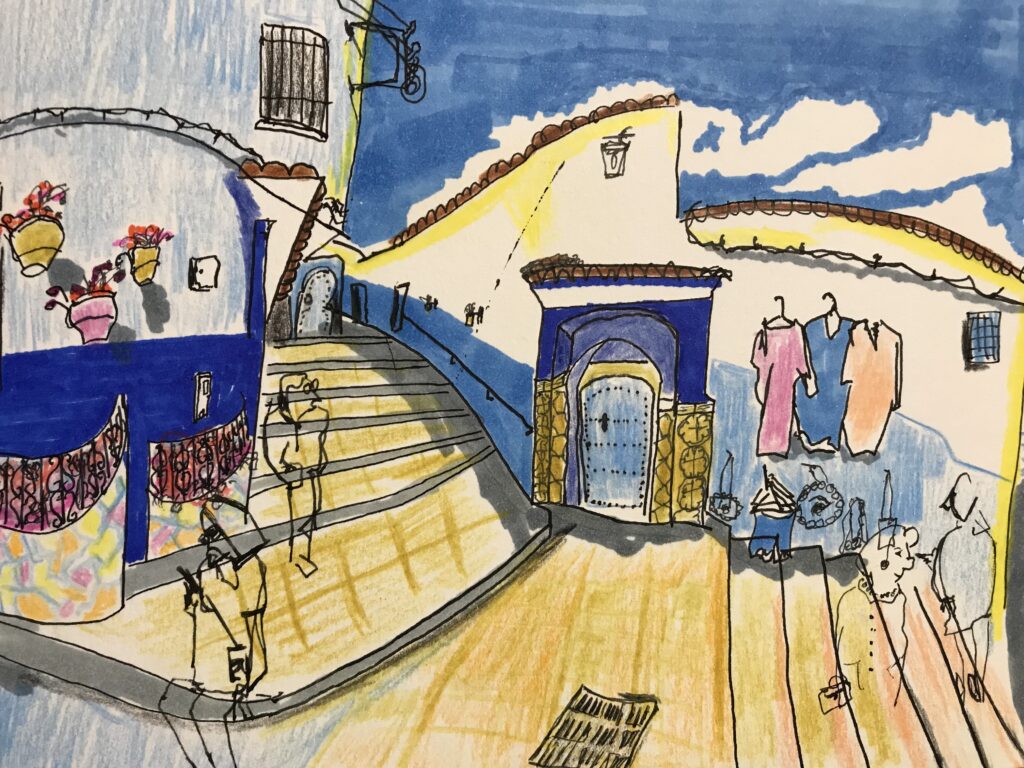
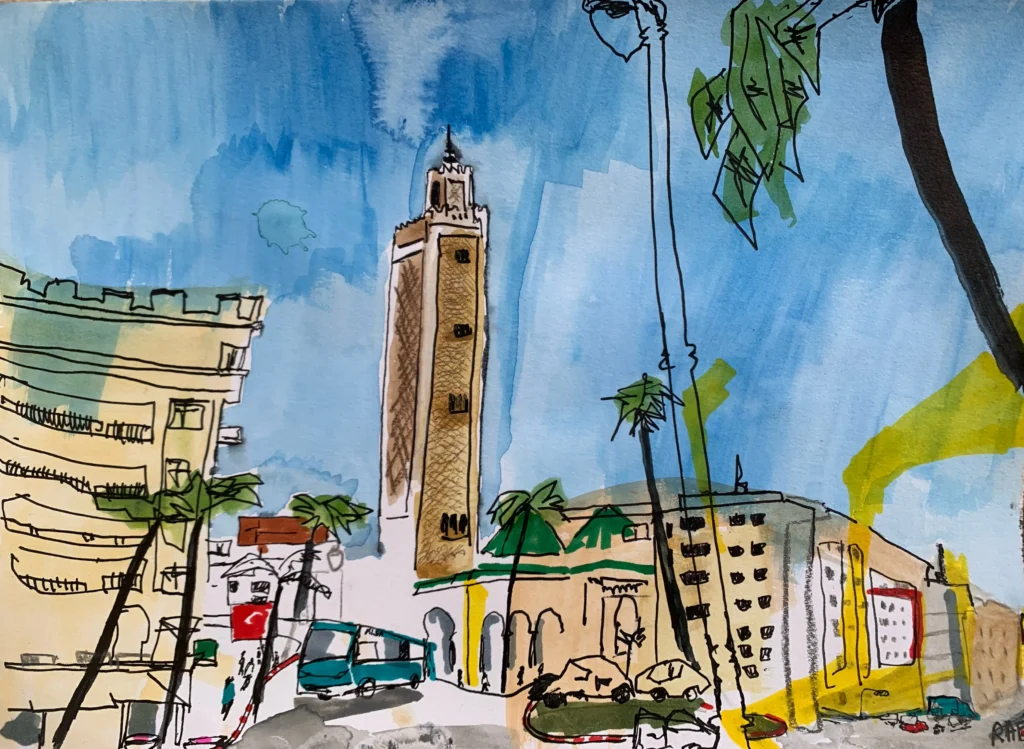
Small cafés where people sit for hours. Busy streets near Grand Socco. Quiet corners in the medina. The view of the port. Cinema Rif. Even random spots where nothing “special” is happening, but somehow everything feels alive.
Over the years, I’ve sketched all kinds of places around Tangier.
Each place has its own energy.
Sometimes I go for a line and wash approach. A quick pen sketch, then a bit of watercolor to bring it to life. Other times I keep it raw, just ink lines, letting the imperfections stay visible.
What I learned is this: the drawing doesn’t need to be perfect. It just needs to be honest.
A slightly crooked building, a loose figure, an unfinished corner. That’s part of the story. That’s proof you were there.
Urban sketching teaches you to let go of control and trust your eye.
From Sketchbook to Motion: Tangier In Motion
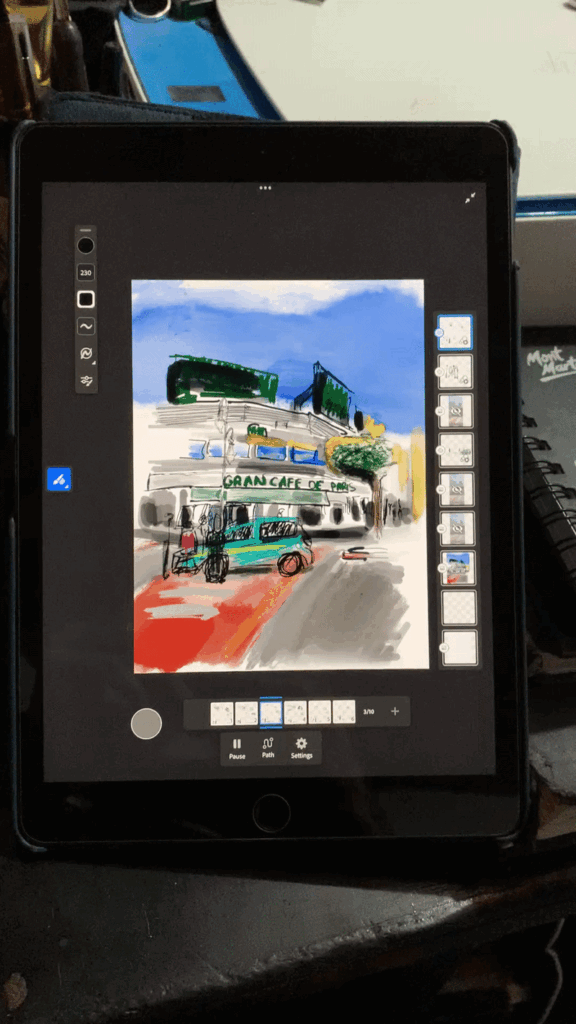
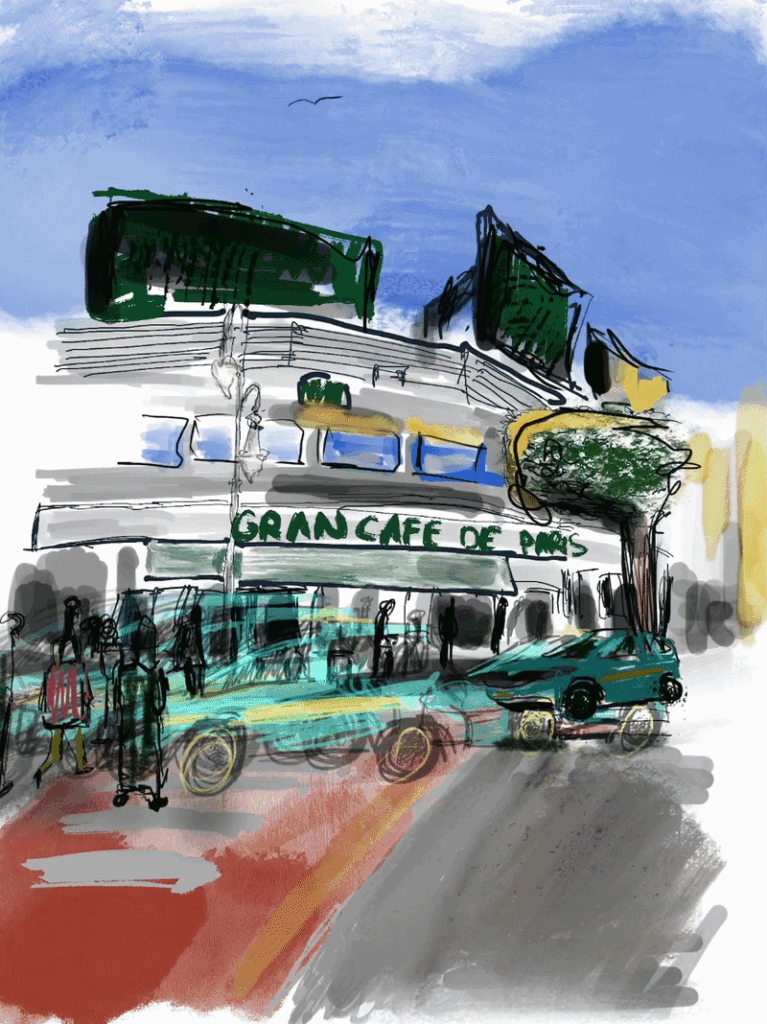
In 2024, I took this idea a bit further with my series “Tangier In Motion.”
Instead of keeping the sketches still, I started animating them.
Not in a heavy, complex way. Just small movements. A flag waving. A car passing. Light shifting. Subtle motion that makes the sketch feel alive.
It was still urban sketching at its core. Drawn from real places. Real observations. But now the city could breathe inside the drawing.
That project changed how I see sketching. It showed me that urban sketching doesn’t have to stay on paper. It can evolve. It can move. It can become something new while still staying true to the moment.
Sketching Cinema: A Tangier Collaboration
One of the highlights of my journey was working on an urban sketching-style collaboration for the Cinémathèque de Tanger (Cinema Rif).
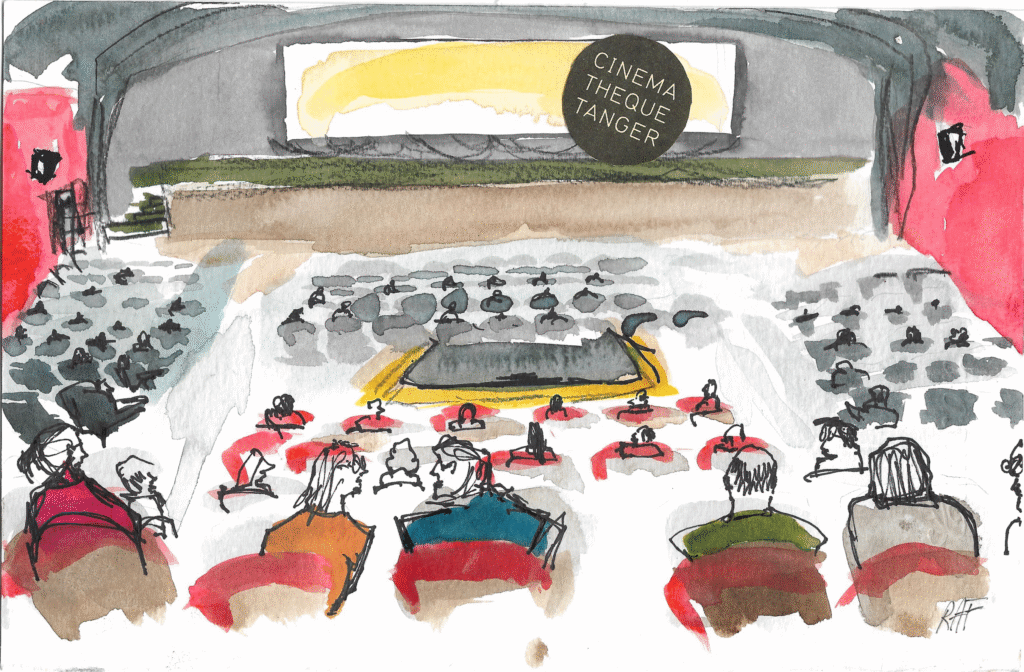
That place already feels like a story. People coming in and out, posters, conversations, light hitting the building at different times of the day.
Bringing urban sketching into that environment made perfect sense. It’s like drawing a scene inside a film, but in your own way.
It reminded me that urban sketching is not just about streets. It’s about culture, places, and the people that give them life.
If You Want to Start Urban Sketching
Keep it simple.

You don’t need expensive tools. A pen, a small sketchbook, maybe some watercolor. That’s enough.
Here’s what I would tell anyone starting:
- Start where you are. Your street, your café, your window view.
- Don’t wait for the “perfect” scene. There isn’t one.
- Draw fast. The city won’t pause for you.
- Accept mistakes. They are part of the sketch.
- Focus on capturing the feeling, not every detail.
Most importantly, go outside and draw. That’s the only real way to learn.
Sharing Your Work: Don’t Keep It Hidden
Urban sketching has always been about sharing.
If you want your work to grow, you need to put it out there.
Here’s how you can start:
- Post regularly on Instagram. Even simple sketches.
- Use relevant hashtags like #urbansketching, #urbansketchers, #tangierart
- Join Facebook groups dedicated to urban sketching and art communities
- Comment on other artists’ work and connect with them
- Share your process, not just the final result
You don’t need a big audience at the start. What matters is consistency and connection.
The urban sketching community is one of the most open and supportive out there. People appreciate honesty more than perfection.
Final Thoughts
Urban sketching changed the way I see Tangier.
It made me slow down. Notice things I would normally ignore. Appreciate small details. Capture moments that would otherwise disappear.
And with projects like “Tangier In Motion,” it also pushed me to experiment and evolve beyond the page.
At the end of the day, it’s simple.
You go out.
You draw what you see.
You tell a story.
One sketch at a time.



Leave a Reply